Kihagyás

MyForge Vault 11.11#

Docs Deploy License: MIT Release Wiki pages ADRs Audits Language Star History

An open-source 8-axis methodology + working tooling for evolving a personal Obsidian-vault into a self-improving knowledge-system. Made by MyForge Labs. Augmented intelligence — NOT AGI, NOT hype. Hungarian+English docs, MIT.

📚 Docs site · 🎬 3-min demo · 🇭🇺 Magyar · 📋 FAQ · 🗺️ Architecture · 📖 The build story (3,900 words)

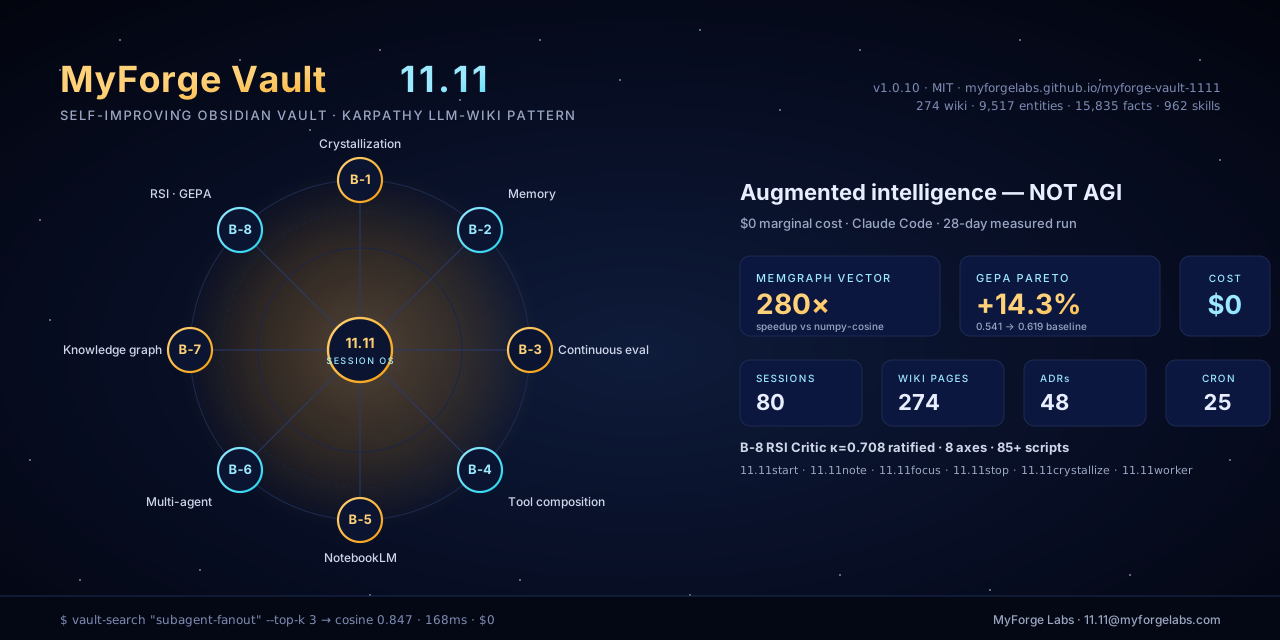
MyForge Vault 11.11 — 8-axis Superintelligent Vault hero banner

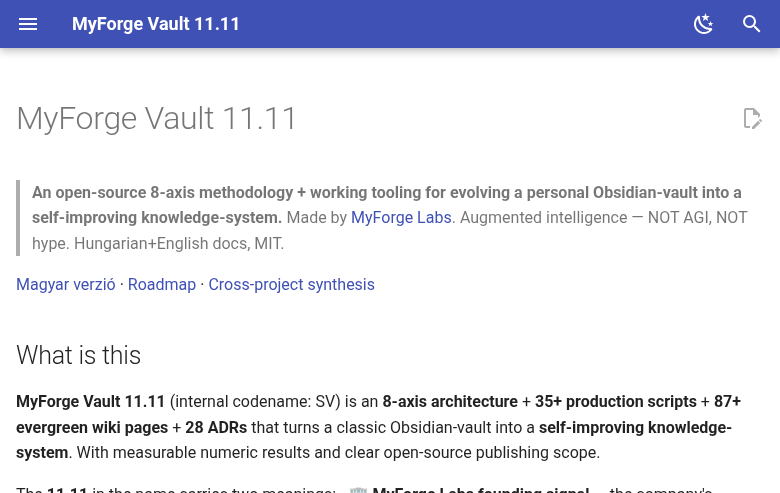
MyForge Vault 11.11 — live docs site screenshot

What is this#

MyForge Vault 11.11 (internal codename: SV) is an 8-axis architecture + 85+ production scripts + 274 evergreen wiki pages + 46 ADRs + 126 audits that turns a classic Obsidian-vault into a self-improving knowledge-system shared by three CLI AI agents (Claude Code, Codex, Gemini). Measurable numeric results, clear OSS scope, MIT-licensed, $0 marginal cost.

If you have 90 seconds: read the FAQ. If you have 5 minutes: read the architecture overview. If you have 15 minutes: read what I learned building it in 5 hours.

The 11.11 in the name carries two meanings: - 🏢 MyForge Labs founding signal — the company's 11.11@myforgelabs.com email predates this vault - 🔧 Session-orchestration primitive — every workflow runs through the 11.11* CLI family (11.11start, 11.11stop, 11.11note, 11.11focus, 11.11ls, 11.11crystallize, 11.11worker) — the connective tissue that makes the 8 axes work as one system

The methodology starts from Karpathy's LLM-Wiki pattern: the "raw input" (10-raw) → "distilled knowledge" (11-wiki) crystallization workflow. SV extends this through evolution along 8 independently developable axes.

The 8 axes#

# Axis Goal Concrete tooling
B-1 Crystallization automation Session → wiki/MEMORY auto-propagation 11.11crystallize, G-Eval prompt v0.3, threshold-ramp
B-2 Memory architecture Lean ~5K context-load (vs 15-20K) Memgraph CE 3.9.0 native vector + bge-m3 + RRF
B-3 Continuous evaluation LLM-output quality monitoring G-Eval + NLI Layer 2.5 + Coherence Layer 2.6 cascade
B-4 Tool composition Discoverable skill-pool vault-skill-search 462 SKILL Memgraph native
B-5 NotebookLM cognitive layer Cross-project synthesis 63-source vault-meta NB + 3-query synthesis
B-6 Multi-agent orchestration Worker + Critic + Summarizer 11.11worker.sh claude-code subprocess
B-7 World-model / knowledge graph Typed entity-extraction 8,913 entities / 19,215 edges (post-cleanup -30.2% noise)
B-8 Recursive self-improvement GEPA prompt mutation gepa.optimize() real loop, Pareto +14.3%
  1. Subagent-fanout dispatcher — 174× parallel LLM-task, $0 cost (Claude Code subscription)
  2. load-session-context — MemGPT-style virtual context loader, 75% token savings
  3. vault-search-server — Unix-socket daemon, 80× speedup (14s→165ms) + Memgraph 280× speedup
  4. Bias-mitigated G-Eval — Claude-to-Claude self-enhancement debiasing, 96.7% calibration agreement
  5. Smart-trigger NLI cascade — fast-baseline → expensive-only-if-needed, 5-10× cost-savings
  6. 4-layer Safety-Gate — ENV + script + git-hook + Critic review (RSI guardrail)
  7. Sprint Day-0 Skeleton-first — ~5× faster Week 1 implementation

Measured results (2026-04-23 → 2026-05-19, 27 days)#

Metric Value
Cost $0 marginal (Claude Code + NotebookLM subscription, NOT Anthropic API)
Session history ~80 closed sessions indexed
Knowledge objects (KO-DB) 13,800+ structured triplets (SQLite)
Entity graph 8,913 entities / 19,215 edges (Memgraph CE 3.9, post-cleanup -30.2% nodes / -21.9% edges)
Skill pool 962 SkillChunks Memgraph native vector-index
Wiki 274 evergreen wikis, 71 English translations (26% coverage)
ADR 46 Architecture Decision Records
Audits 126 one-shot reports
Cross-project synthesis 63-source NotebookLM + 3 podcast episodes
Subagent-fanout iterations 8+ super-sessions (5–14 parallel)
Memgraph vector-index speedup 280× vs numpy-cosine (sub-ms p95)
Smart-rerank latency (Round 3) 18.6s → 8.7s (-55%) via daemon keepalive + delegation
GEPA Pareto improvement +14.3% (baseline 0.541 → 0.619)
LongMemEval-S Recall@5 73.74% v0.3-B (BGE-reranker-v2-m3, K=20); 76.77% K=5 sweet-spot; 67.68% v0.2 hybrid baseline; 46% IDF-only baseline
G-Eval verdict-agreement 96.7% on 30-sample gold-label set
Atomic-write compliance 66/66 scripts lint-clean (vault-atomic-lint --quiet)

Compare to other memory + agent-OSS projects#

This is an honest, opinionated map of where SV sits. Each project below is excellent at what it does; SV is a composite built around a different shape (markdown-vault first, three-CLI-agent-shared, local-by-default).

Feature mem0 Letta GraphRAG agentmemory MyForge Vault 11.11
Markdown-first store ❌ JSON ❌ DB ❌ DB ❌ DB ✅ Obsidian-compatible
3-CLI-agent bridge ✅ Claude+Codex+Gemini
Karpathy LLM-Wiki pattern partial ✅ explicit 10-raw/11-wiki split
Local-first, $0 marginal partial ❌ (LLM API) partial
Knowledge-graph ✅ Memgraph + 100% typed
Native vector-index ✅ Qdrant ✅ Chroma ✅ Memgraph 280× speedup
G-Eval LLM-as-judge partial ✅ 96.7% verdict-agreement
NLI 2.5/2.6/2.7 cascade ✅ smart-trigger optional
GEPA Pareto RSI ✅ +14.3% verified
NotebookLM cognitive layer ✅ 2-host podcast layer
Constitutional 4-layer safety ✅ atomic + flock + git + critic
Session-orchestration CLI 11.11* family
MCP server ✅ 7 read-only tools (Round 3)

Where SV is NOT the right pick:

  • If you want a hosted memory SaaS with multi-tenant isolation and a Python SDK, use mem0
  • If you want a persistent agent runtime with full state checkpointing, use Letta
  • If you want GraphRAG specifically (Microsoft's community-detection + hierarchical summarization), use the original GraphRAG
  • If you want a simple key-value memory with confidence scoring and zero graph infrastructure, use agentmemory

Where SV IS the right pick (after evaluating the above):

  • you run multiple CLI agents on one machine
  • you already use Obsidian and the markdown-first format matters
  • you want the build-as-you-go vault to BE the artifact, not a side-effect
  • you want a reference implementation of Karpathy's LLM-Wiki pattern that actually runs

Compare to other agent-skill repos#

Different category — Pocock/skills, obra/superpowers, tinyhumansai/openhuman are skill-libraries that any agent loads. SV shares this property (962 indexed SkillChunks) but doesn't compete on the skill-library axis. Use these alongside SV:

Feature Pocock/skills obra/superpowers tinyhumansai/openhuman MyForge Vault 11.11
Skill share ✅ + Memgraph vector
Persistent knowledge-graph ✅ Memgraph 8,913 entities
Markdown-vault as the substrate ✅ Obsidian-native
11.11* session-orchestration ✅ unique CLI family

Quick start (≈ 15 min, all-deps fresh)#

# 1. Clone
git clone https://github.com/MyForgeLabs/myforge-vault-1111.git
cd myforge-vault-1111

# 2. Memgraph CE (Docker)
docker run -d --name memgraph -p 7687:7687 memgraph/memgraph:latest

# 3. Python deps
make install          # or: pip install -r requirements.txt

# 4. Embed the wiki content
./scripts/vault-embed.py --backfill 11-wiki/

# 5. Try a search
./scripts/vault-search "Karpathy LLM-Wiki pattern"

Verify:

make test             # runs the LongMemEval-S fast regression-gate
make build-docs       # mkdocs build --strict

make help lists everything. See the FAQ for the "works on my machine" checklist (OS support, Python version, common friction).

Architecture in one diagram#

A full Mermaid diagram lives in 11-wiki/architecture-overview.en.md. The short version:

   📥 INPUT          🔮 CRYSTALLIZE        🧠 MEMORY          ✨ DISTILLED
   sessions    ──▶   /11.11stop hook  ──▶  KO-DB (SQLite) ──▶ 11-wiki/
   raw/external      G-Eval scorer         Memgraph CE        07-Decisions/
   browser-hist      Constitutional       (vector + graph)    06-Audits/
   3 CLI agents      Critic gate (4-lyr)   bge-m3 + reranker  02-Projects/
                          │                      │
                          ▼                      ▼
                     🛠️ TOOLING (vault-search · vault-mcp · 962 skills)
                     📊 EVAL + RSI (LongMemEval-S gate · GEPA · Tier-2 RSI)
                     🎙️ COGNITIVE (NotebookLM cross-project synthesis)

Reproducibility#

The full methodology is architecture-level reproducible through the 07-Decisions/ ADRs + 11-wiki/ evergreen wikis. Every script is idempotent, ENV-flag-gated, default-OFF safety pattern.

Positioning (transparent)#

MyForge Vault 11.11 is NOT a "Pocock-skills alternative" or "openhuman challenger". The methodology is an 8-axis composite architecture with measurable results, used on MyForge Labs' own Obsidian-vault, published as open source. Goal: industry peer feedback + anyone else reproduces it on their own vault.

Who's behind it#

MyForge Labs — small Hungarian engineering shop building agent-skill infrastructure, multilingual web platforms, and AI-augmented operational tooling. Founded around 11.11.

Maintainer: Peti Markovics (@petimarkovics · peti.markovics@gmail.com).

Contributors#

This project is AI-aided by design, not by accident. The three CLI agents listed below are co-collaborators, not tools. Every commit is stamped with an AGENT= env-var so you can git log --grep='AGENT=' to see which agent did which work.

Contributor Role Touched
Peti Markovics (@petimarkovics) Maintainer, vision, architecture decisions everywhere
Claude Code (Anthropic, Opus + Sonnet) Primary implementor; subagent-fanout dispatcher; long-form writing scripts, wikis, the Karpathy-style essay, this README
Codex CLI (OpenAI) Code review second opinion; refactor passes; alt-perspective ADRs refactors, ADR reviews
Gemini CLI (Google) Multimodal pre-processing; session-context patterns NotebookLM-bridge work, image-handling tooling
NotebookLM (Google) Cross-project synthesis subroutine; 2-host podcast generation 06-Audits/*-NotebookLM-* and .vault-nb/audio-overviews/

If you want to be listed here, open a PR. Human OR agent contributors welcome.

Acknowledgements#

  • Andrej Karpathy — for the original LLM-Wiki gist this whole project is built on
  • Memgraph team — for shipping a CE with native vector-index and no licensing wall
  • BAAI — for bge-m3 and bge-reranker-v2-m3 (multilingual, CC-BY)
  • Anthropic / OpenAI / Google — for the CLI agents that made the AI-aided-build feasible
  • The Obsidian community — for normalizing markdown-first knowledge work

License#

MIT — see LICENSE. Cherry-pick freely, attribution-friendly.

⭐ Star history [![Star History Chart](https://api.star-history.com/svg?repos=MyForgeLabs/myforge-vault-1111&type=Date)](https://star-history.com/#MyForgeLabs/myforge-vault-1111&Date)
🛠️ Built with [Memgraph CE 3.9](https://memgraph.com) · [bge-m3](https://huggingface.co/BAAI/bge-m3) · [bge-reranker-v2-m3](https://huggingface.co/BAAI/bge-reranker-v2-m3) · [Claude Code](https://www.anthropic.com/claude-code) · [Codex CLI](https://github.com/openai/codex) · [Gemini CLI](https://github.com/google/gemini-cli) · [NotebookLM](https://notebooklm.google.com) · [mkdocs-material](https://squidfunk.github.io/mkdocs-material/) · [Obsidian](https://obsidian.md) · [SQLite](https://www.sqlite.org/) · [graphify](https://github.com/grafify/grafify) · [Anthropic API SDK](https://docs.anthropic.com) Released under MIT — see [LICENSE](LICENSE).
📄 Cite this work If you use this in research, please cite via [CITATION.cff](CITATION.cff). BibTeX:
@software{markovics_2026_myforge_vault,
  author       = {Markovics, Peti},
  title        = {{myforge-vault-1111: A self-improving Obsidian
                   vault for CLI AI agents}},
  year         = 2026,
  version      = {1.0.9},
  url          = {https://github.com/MyForgeLabs/myforge-vault-1111}
}